
Jackson County Criminal Court Cases
Jackson County Superior Court hears felonies in the Piedmont Judicial Circuit. State Court handles misdemeanors and traffic cases outside exclusive municipal jurisdiction. Magistrate Court issues many warrants, conducts first appearances and preliminary matters, and handles its narrower statutory work. Municipal courts keep their own ordinance and qualifying traffic or misdemeanor dockets. The Clerk of Courts holds Superior, State, Juvenile, and now Magistrate filings at 5000 Jackson Parkway, Suite 150.
Use the case court and case number to avoid mixing venues. Superior Court is in Suite 330, State Court in Suite 250, Magistrate Court in Suite 230, and Juvenile Court in Suite 210. Juvenile records have special access limits. The clerk's main number is 706-387-6246; State Court is 706-387-6346 and Magistrate Court is 706-387-6358.
Jackson County Courts Divide the Charges
Georgia does not sort crimes into Class A, B, and C felonies. A felony is generally an offense punishable by death, life, or more than 12 months, so Superior Court is the felony trial venue. State Court receives most county misdemeanors. A booking charge can change after review, and the District Attorney or State Court Solicitor files the operative charging paper.
| Court | Main criminal role | Contact |
|---|---|---|
| Superior Court | Felony trials and related serious matters | Clerk 706-387-6246 |
| State Court | Misdemeanors and traffic | 706-387-6346 |
| Magistrate Court | Warrants and preliminary matters | 706-387-6358 |
| Municipal courts | Ordinances and limited traffic or misdemeanor cases | City-specific court |
A Magistrate warrant or first-appearance entry is not the final disposition. Follow the accusation or indictment into the trial court.
Searching Jackson County Case Records
Open the Jackson Clerk WebCaseSearch and choose a criminal court or case type when that control is available. The exact interface redirected during research, so labels may change. Search is free. An account is requested only for printing, and PeachCourt is an account-gated document route rather than a complete free statewide database.
- Choose the criminal division and likely Jackson County court.
- Enter the case number when available, or search the party name with spelling variants.
- Narrow broad results by file-date range and court or case type.
- Open the docket, then read charges and outcomes count by count.
- Ask the clerk for a plain or certified copy, or call ahead for an archived file.
These controls are a functional inventory, not a claim that every current label was observed:
| Field label | Type | Required | Notes |
|---|---|---|---|
| Name or Party | Text | One search key | Try surname and full legal name |
| Case Number | Text | Alternative | Best from a notice or pleading |
| File Date range | Date pair | No | Narrows broad name results |
| Court or Case Type | Dropdown | No | Select criminal and the proper venue |
| Search or Reset | Button | No | Runs or clears the query |
The PeachCourt access page is the source for the image below.

The account gate affects document printing and access, not the legal meaning of the clerk-held record.
Archived Jackson County Criminal Files
Pre-1998 criminal cases may be in storage and may not appear in a modern Jackson County court search. Call the clerk at least 24 hours ahead. Give the party name, approximate year, court, and case number if known. At the counter, confirm whether a plain or certified copy best fits the need. Cash, money order, cashier's check, and cards are accepted; card payments add 4 percent.
The archive route matters because an absent web result is not proof that no file exists. The working courthouse began service in 2004, while the historic archives retain older State Court and jail books. Historical holdings can support genealogy but cannot bypass a sealing order or juvenile restriction.
Note: A clerk account needed to print does not make an otherwise public counter record confidential.
Inside a Jackson County Case File
A court case file shows what prosecutors filed and what the judge did. It differs from a police report, which describes the incident, and from a jail entry, which captures custody and charges at intake. Documents and docket entries may require an account or direct clerk request.
| Case number and court | Identifies the venue and the specific proceeding. |
|---|---|
| Charging document | An accusation, indictment, complaint, or citation states filed allegations. |
| Docket entries | The dated record of filings, hearings, orders, and other events. |
| Hearings and bonds | Scheduled appearances, bond rulings, and related conditions. |
| Disposition and judgment | The result for each count, including dismissal, acquittal, plea, or conviction. |
| Sentence and money | Custody, probation, restitution, fines, and court financial entries. |
Protected addresses, personal identifiers, victim or minor details, sealed material, and some documents can be redacted or absent from the public view.
Reading Jackson County Docket Outcomes
Do not infer the outcome from the case caption or first charge. A prosecutor may amend counts, and each count can end differently. The docket and judgment should be read together.
- Accusation
- A Georgia prosecutor's formal charge, often used without an indictment.
- Indictment
- A grand jury's returned true bill.
- Nolle prosequi
- The prosecutor formally declines to continue that prosecution.
- Acquittal
- A not-guilty outcome.
- Disposition
- The final result of a charge or count.
- Docket
- The chronological list of case events.
A dismissal or acquittal is not a conviction. It also does not automatically remove the earlier arrest or booking product from every separate custodian.
How a Criminal Case Moves
A local case may begin with arrest or citation, followed by first appearance and a bond decision. The prosecutor reviews the event and may file an accusation or seek an indictment. Arraignment records the plea. Motions, discovery, negotiations, and trial preparation follow. The case ends through dismissal, plea, acquittal, or conviction, followed by sentence and possible appeal.
Jackson County case flow: Charges Filed › Arraignment › Pretrial › Plea or Trial › Disposition › Sentencing
The District Attorney's Jackson office prosecutes Piedmont Circuit felonies, while the State Court Solicitor handles misdemeanors. Specialty Court supports Felony Drug Court, Veterans Treatment Court, Family Treatment Court, and Wellness Court. A public docket can name a program review, but treatment detail may remain confidential.
Jackson Court Sealing After GCIC Restriction
Georgia record restriction limits eligible GCIC history from ordinary public dissemination. It does not itself seal every Jackson County court page. A person should obtain the complete GCIC history, identify the OTN or SID and arrest date, and secure the court disposition. Post-July 1, 2013 arrests generally route through the prosecutor; older arrests follow the prior agency application route.
After GCIC restriction, an eligible person may petition the court under O.C.G.A. §35-3-37(m) to seal the public court file. Confirm the current form and filing fee with the clerk because the research did not verify a local posted fee. Correction also begins with the source: the arresting agency fixes arrest data, while the court or prosecutor supplies disposition documentation.
Federal Jackson County Criminal Cases
Federal cases belong to the Northern District of Georgia, not the Jackson clerk. PACER is the official federal docket and document system after registration. Current charges are generally $0.10 per page with a $3 cap on most reports and documents, while courthouse-terminal viewing and opinions are free; live PACER terms should be checked because a 2027 increase has been announced.
The PACER image below comes from its official service page.
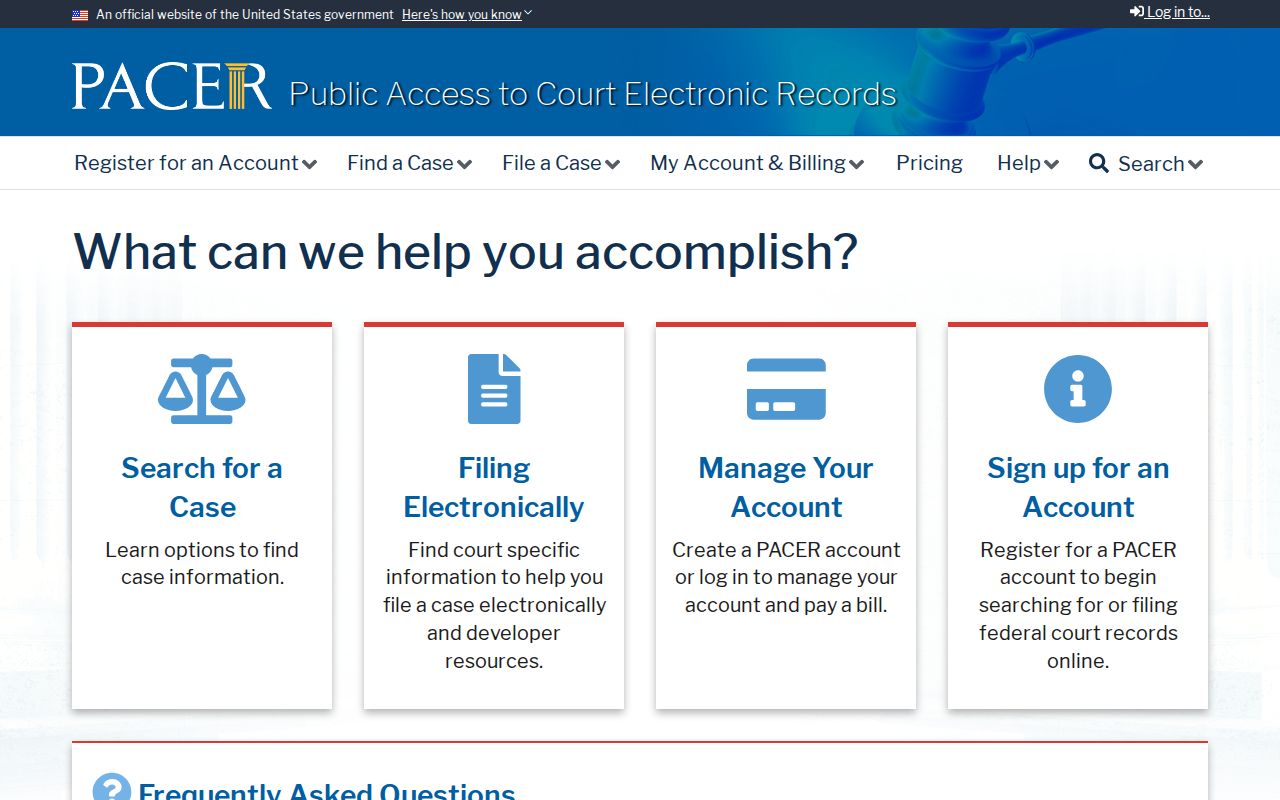
A federal docket does not appear in Jackson County WebCaseSearch.
The serving court is the Gainesville Division of the U.S. District Court for the Northern District of Georgia. Its official image follows.
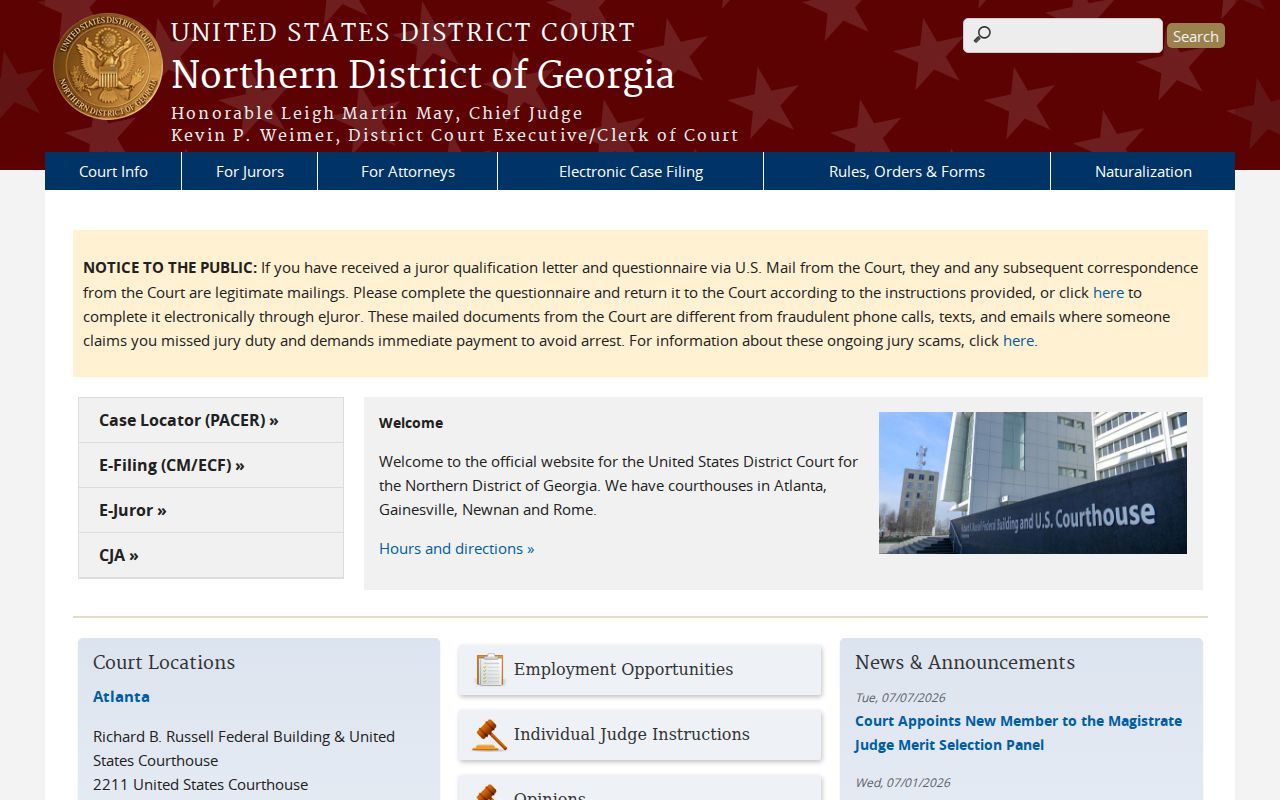
The Gainesville clerk counter is a federal channel; federal custody later belongs to the Bureau of Prisons rather than Jackson County Jail or GDC.
Case Record Access & Restrictions
Georgia favors access to public records, but not every item is open. Juvenile matters, sealed records, protected victim or minor information, personal identifiers, and some active investigative material can be withheld or redacted. Grand-jury deliberations remain secret even when a returned indictment becomes a court filing. Online display may also be narrower than the paper file.
The Georgia Superior Court Clerks' Cooperative Authority supplies statewide clerk resources, shown in the source image below.
Statewide routing does not turn Georgia into one complete trial-case database. Jackson's clerk remains the custodian for Jackson County Superior and State filings.
When no online document appears, note the case number and docket entry, then ask the clerk whether the document is public and available by account, counter copy, or archive retrieval. The broader Jackson County criminal history overview explains how the court file fits with booking and GCIC records.